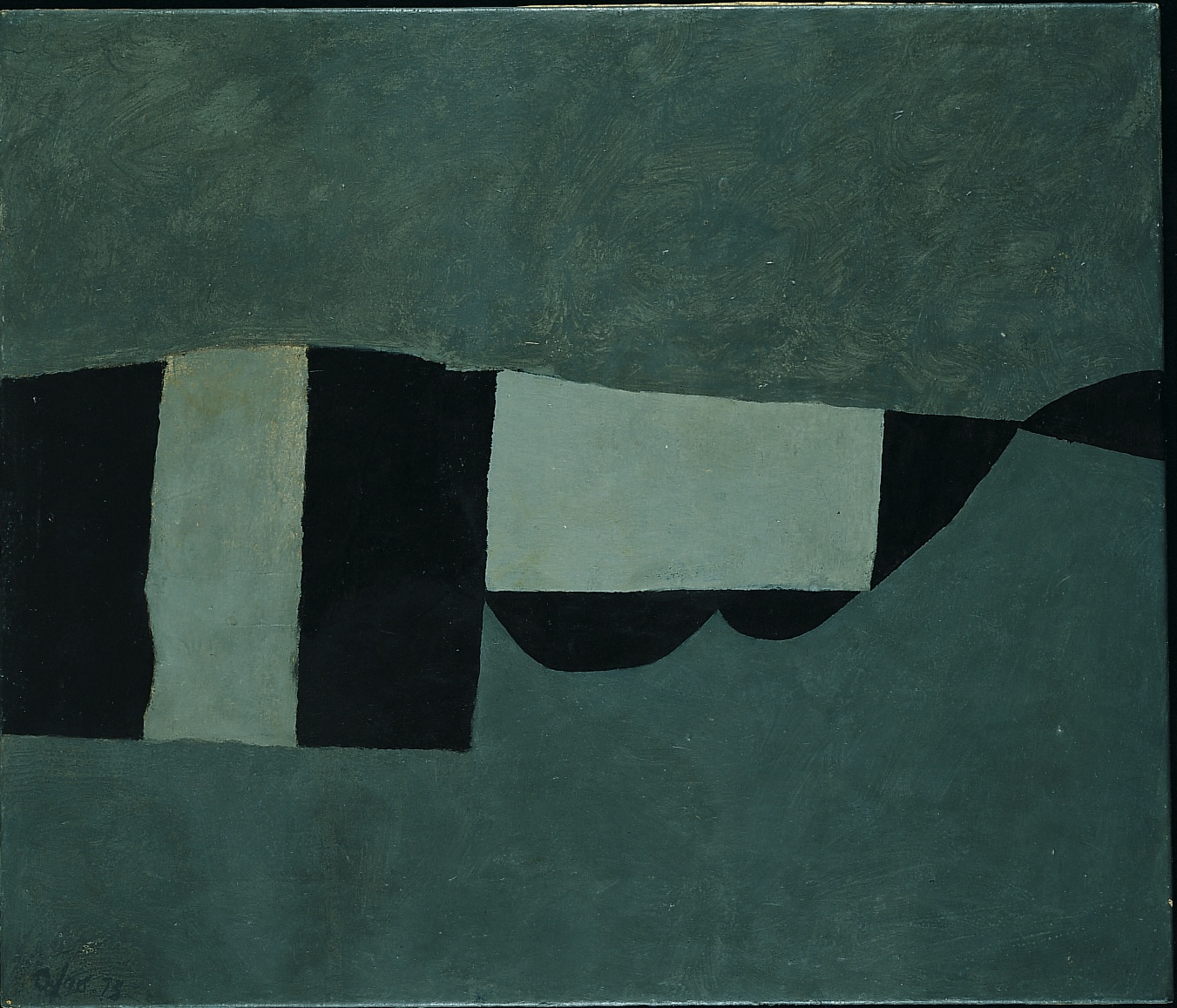
Rome-Tehran: Parallel Avantgardes
In collaboration with Ab-Anbar gallery, Artvisor is pleased to present Rome–Tehran: Parallel Avantgardes, opening on June 4th, an exhibition tracing the artistic dialogues and resonances that emerged between Italy and Iran from the 1950s to the 1970s.
In a brief moment between the 1953 coup and the 1979 revolution in Iran, dialogues and exchanges between Italy and Iran heightened. The exchanges were driven by institutional infrastructures: academies of fine arts in Rome, Florence, and Venice; international exhibitions such as the Venice Biennale; and transnational networks of galleries, critics, and patrons. Despite their different trajectories, one marked by the aftermath of totalitarianism and war, the other by foreign intervention and internal repression, both societies experienced a shared condition of historical fracture, in which the promises of modernity appeared compromised and politics increasingly unreliable. The comparison suggests that modernity, when experienced as rupture rather than progress, generates recurrent emotional and perceptual states across separate geographies: a sense of loss, estrangement, and the urgent need to reinvent meaning. In this sense, the dialogue between Italy and Iran in the 1950s exposes modernism not as a Western narrative exported elsewhere, but as a shared human condition, a way of confronting the fragility of political ideals, the instability of identity, and the persistent desire to rebuild forms of expression when established structures of meaning have collapsed.
Aiming to challenge linear and Eurocentric narratives of modernism, the exhibition brings together five key Iranian modernist figures alongside their Italian contemporaries within a dynamic network of conversations and resonances. The exhibition does not unfold through rigid pairings but through interrelated chapters, with artists entering into multiple dialogues, producing a fluid curatorial structure in which shared concerns are articulated through diverse visual vocabularies, material strategies, and conceptual approaches.
Matter & Material
Across Italy and Iran, the turn toward found and readily available materials constituted a radical rethinking of artistic language in response to the conditions of postwar modernity. Burlap, plastic, sand, earth, metal, straw, and vernacular objects were considered as historically charged substances, embodying labour, scarcity, landscape, and everyday life. In Italy, from Alberto Burri’s burlap sacks to the material experiments of Arte Povera twenty years later, the use of found and industrial matter destabilised the aesthetic hierarchies of modernism and challenged the ideology of progress embedded in consumer capitalism and technological advancement. In Iran, following the 1953 coup and the later phase of state-led modernisation driven by urban redevelopment, infrastructural expansion and rapid industrial growth, artists such as Mohsen Vaziri-Moghaddam and Marcos Grigorian turned to sand, earth, straw to re-inscribe local histories and sensory experience into the language of modernism.
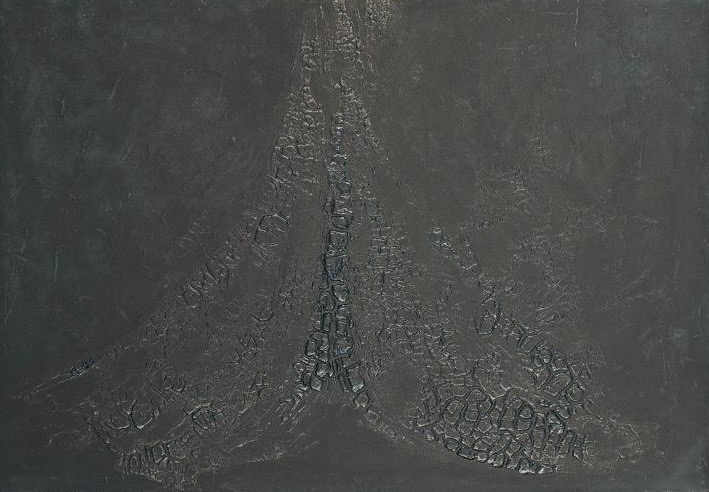
Alberto Burri, Cretti: C (Cracks: C), 1971, etching and aquatint with embossing on Fabriano card
Colour & Gesture
Across postwar Italy and mid-century Iran, a shared painterly language emerges in which colour and gesture are no longer subordinate to form, but become primary vehicles of expression. Italian artists such as Afro Basaldella and Carla Accardi foregrounded chromatic vibration and sign-like inscription, dissolving the hierarchy between figure and ground. In parallel, Iranian artists including Behjat Sadr and Mohsen Vaziri-Moghaddam approached the surface as an active field, where colour is mobilised through repetition and rhythmic accumulation. Sadr’s palette-knife technique, at once painterly and calligraphic, generates movement through the insistence of gesture, while Vaziri-Moghaddam’s sand paintings extend this logic into tactile and optical domains, producing a form of “structural space” grounded in material process.
Across both contexts, gesture becomes a temporal act, registering the artist’s presence while simultaneously destabilising the image. Colour, in turn, operates not as description but as force: a means of opening the surface, intensifying perception, and transforming painting into an event unfolding in time.
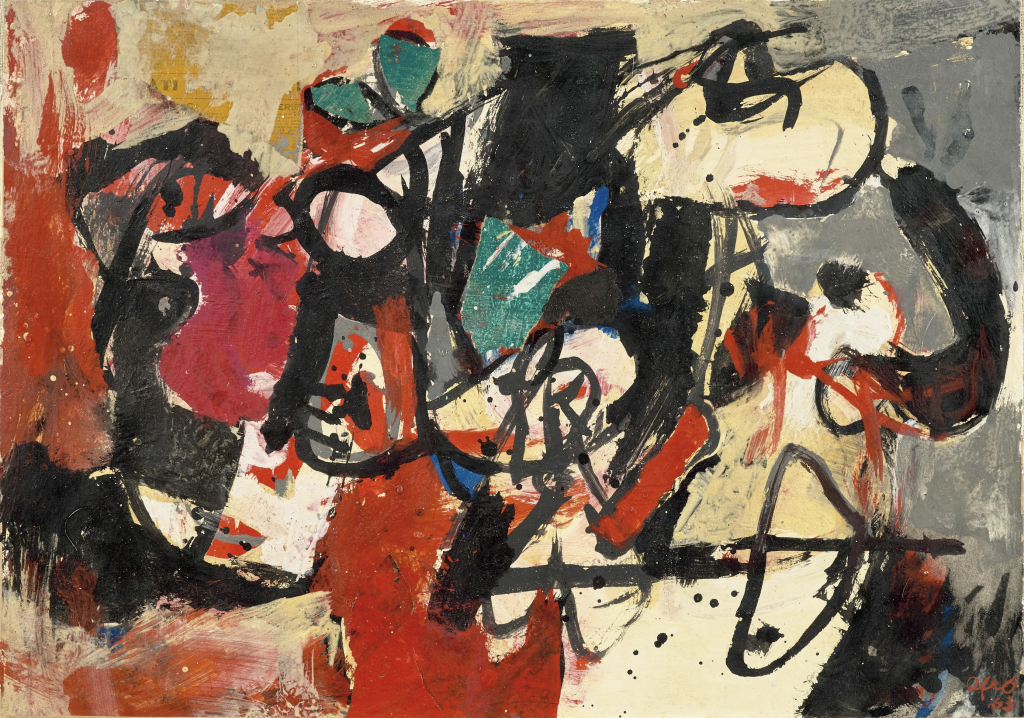
Afro Basaldella, Percorso di caccia, 1963, Signed and dated, oil and collage on paper laid down on canvas
Form & Space
If colour and gesture articulate a temporal dimension, form and space become the locus of a more structural interrogation of the artwork. In Italy, figures such as Mirko Basaldella and Luigi Boille challenged the stability of form through fragmentation, spatial ambiguity, and anti-monumental strategies that resist closure. This destabilisation finds a parallel in Iran, where artists reconfigure figuration as a field of tension between coherence and dissolution. Bahman Mohasses radicalises this condition through hybrid, grotesque bodies that appear structurally incomplete, undoing the centrality of the human figure and prefiguring posthuman imaginaries. Parviz Tanavoli, by contrast, displaces the figure into systems of signification, where sculptural form operates as a spatial syntax – an interplay of symbol and linguistic reference. Across both geographies, space is no longer a neutral container but an active construct: a site where form is continuously reconstituted, reflecting broader questions of modern subjectivity and the limits of representation.
Artists
Mohsen Vaziri-Moghaddam, Behjat Sadr, Bahman Mohasses, Parviz Tanavoli, Marcos Grigorian, Afro Basaldella, Alberto Burri, Carla Accardi, Luigi Boille, Mirko Basaldella
Rome-Tehran: Parallel Avantgardes
Curated by Salman Matinfar and Piero Tomassoni
Ab-Anbar gallery, London
4 June – 12 July 2026